


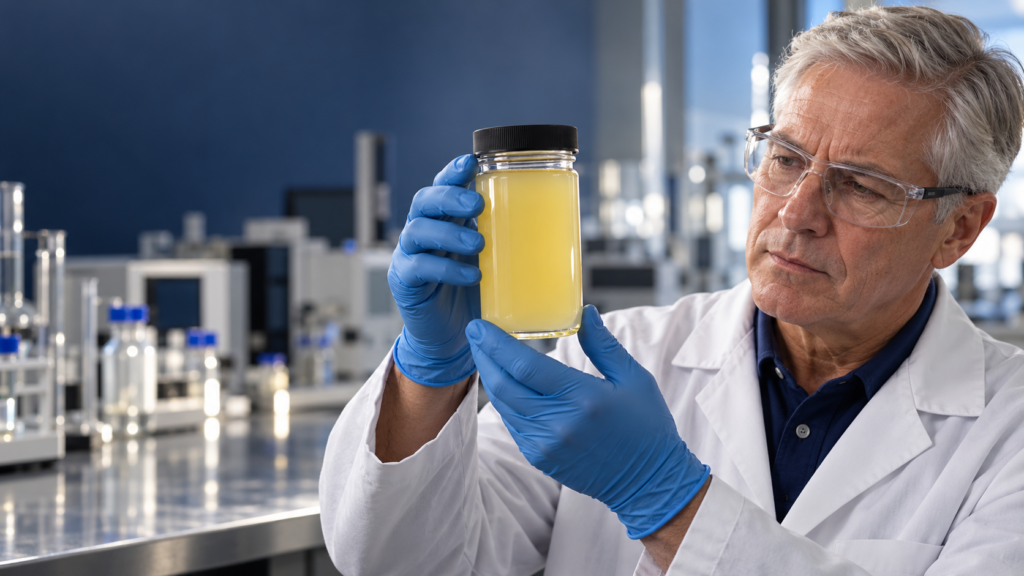
Cloudy fuel does not always mean water contamination. Water droplets, cold-weather wax, fine dirt, and aging fuel can all cause haze. Testing helps you choose the right treatment.
Water can appear in fuel in three forms:
- Suspended or emulsified water: Tiny droplets mixed throughout the fuel. They may make it cloudy or milky.
- Dissolved water: Water held within the fuel that you generally cannot see.
- Free water: Water that has separated and collected at the bottom.
Check a Fuel Sample
- Collect a sample using a Dieselcraft FCT-100 Test Kit. Note the fuel temperature and inspect the sample before shaking. Take a separate sample from the tank bottom to check for collected water.
- Let it stand undisturbed for several hours or overnight. Do not add the water-detection capsule during this observation period. Photograph the sample at the start and again after settling.
- Look for changes. A water layer forming at the bottom shows that droplets are separating. If the fuel stays cloudy, the cause could be water droplets that resist settling, wax, or fine particles.
- Use the water-detection capsule according to the kit instructions. It checks for water but does not, by itself, prove that the water is emulsified.
- If the cause remains unclear, ask a fuel laboratory to investigate. Karl Fischer testing measures water content, but that number alone does not tell you whether the water is dissolved or present as droplets.
Suspended Water or an Emulsion?
These terms overlap. Both describe water droplets mixed into fuel.
The practical difference is how easily the droplets separate. Droplets that settle readily form an unstable mixture. Droplets that remain mixed for a long time form a more stable emulsion. Settling time and temperature affect what you observe.
How Can the Water Be Removed?
Dieselcraft fuel-polishing equipment can separate suspended water when operated at the appropriate flow rate and conditions. Before-and-after testing verifies the results. Truly dissolved water requires a different treatment.
Some stubborn emulsions may benefit from a demulsifier—an additive that helps small water droplets join together so they can settle or be separated. Chemicals are not always necessary.
Stanadyne Performance Formula contains water demulsifiers, but its effectiveness depends on the fuel and the emulsion. Confirm compatibility with your fuel, especially R99, and test a small sample at the recommended dose before treating the tank. Available at: https://link.amazon/B0eBHR88L
After treatment, the separated water must still be drained or removed. Avoid additives designed to keep water mixed into the fuel when your goal is separation.
For help with fuel testing and polishing equipment, contact Dieselcraft at 530-613-2150 or visit dieselcraft.com.
Recent Comments