


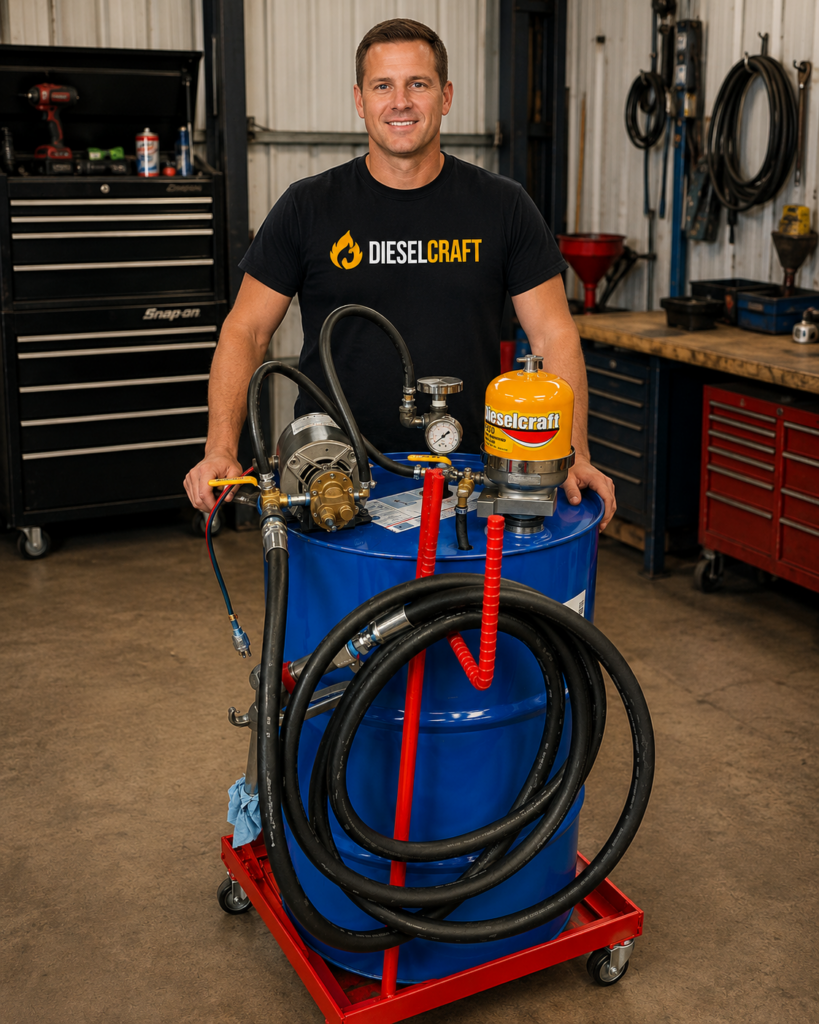
Choosing the right oil centrifuge system can save you time, labor, and long-term costs. Below is a direct comparison between a Dieselcraft pressure-driven system and typical tabletop gravity-fed units.
Dieselcraft Pressure-Driven Systems
Performance & Flow Rate
- Magnum 60: 60 gallons per hour
- OC-50: 100 gallons per hour
- Rated for continuous use
Fluid Compatibility
Handles diesel fuel, WVO, motor oil, biodiesel, ATF, and gear oil.
Proper Oil Heating
Oil must be heated to break the viscous bond between solids and oil and to remove water. Dieselcraft includes a drum heater designed for proper pre-heating.
Cleaning Power
2600 G-force
What’s Included
- Centrifuge unit
- 55-gallon drum mounting plate
- Thermometer
- 1200 watt drum heater
- Suction wand with strainer
- Pump and motor
Real-World Example:
50 gallons may take ~2 hours to heat and ~2 hours to process (two passes). Total: ~4 hours.
Pump Advantage
Transfer oil easily without lifting tanks or relying on gravity.
Maintenance
- Optional paper liner allows 3-minute cleaning
- Only wear part: rotor bushings
- Minimal replacements over 10+ years
Pricing
Contact Dieselcraft for Current Pricing
Tabletop Gravity-Fed Systems
Flow Rate
- 5–25 gallons per hour
Heating Limitations
Inline heaters attempt to heat oil to 180°F instantly, resulting in inconsistent performance. Heater is typically not included (+$300).
Here are the facts when it comes to inline table top heates:
A 1,000-watt heater cannot raise oil from 70°F to 180°F at 1 gallon per minute in one pass.
Assuming typical waste/motor oil properties:
- Oil flow: 1 GPM
- Required temperature rise: 110°F
- Heat required: approximately 6,400–6,800 watts
- Allowing for heat loss: use roughly a 7,500-watt heater
With a 1,000-watt heater at 1 GPM:
- Ideal temperature increase: approximately 16–17°F
- Expected outlet temperature: approximately 86°F
- Real-world outlet temperature may be closer to 82–85°F because of heat loss.
To reach 180°F in one pass with a 1,000-watt heater, flow would need to be approximately:
Approximately 1 gallon every 6½–7 minutes or 0.15 GPM
For a 50-gallon batch of oil, heated from 70°F to 180°F with a 1,000-watt heater:
In an uninsulated steel drum or cold environment: possibly 9–12 hours
Theoretical heating time: approximately 5.8 hours
Realistic time with normal heat loss: approximately 7–9 hours.
This means it can take most of the day for the oil to reach the proper operating temperature. Below 180°F, the oil remains thicker and holds entrained water and contaminants longer, reducing separation efficiency.
For heating used motor oil to approximately 180°F, Watt density of:
- 8–12 watts per square inch for dependable operation
- 15 W/in² maximum when the oil is continuously circulating
- 3–8 W/in² for very dirty, heavy or slow-moving waste oil
The WVO Designs/Tempco element is rated at 39 W/in², which is quite high for dirty motor oil. It may heat successfully with strong continuous flow, but it creates a greater risk of:
- Oil baking or coking onto the element
- Localized overheating
- Sludge buildup
- Shortened element life
- Reduced heat transfer as deposits accumulate
Cleaning Power
~1200 G-force (optional boosters available)
Processing Time
50 gallons at 5 GPH = ~10 hours total
System Limitations
- Gravity-fed operation
- No pump included
- Additional fittings required
- Manual oil transfer often needed
Maintenance
All centrifuge systems require cleaning. Despite claims, tabletop systems are not mess-free.
Cost Breakdown
- Base unit: ~$1,800 plus
- Heater: +$375
- Cleaning booster: +$100
- Total: $2,275+ (plus shipping)
Side-by-Side Comparison
| Feature | Dieselcraft | Tabletop Units |
|---|---|---|
| Flow Rate | 60–100 GPH | 5–25 GPH |
| Duty Cycle | Continuous | Limited |
| Heating | Drum heater included | Inline (limited) |
| Cleaning Power | 2600 G’s | ~1200 G’s |
| Pump | Included | Not included |
| 50 Gal Processing Time | ~4 hours | ~10 hours |
| Maintenance | Minimal | Moderate |
| Total Cost | Complete system | $2,200+ with add-ons |
The Bottom Line
Dieselcraft systems deliver higher throughput, better separation, lower labor time, and longer service life. Tabletop systems may appear cheaper upfront but require more time, add-ons, and manual work.
Get the Right System the First Time
Avoid wasted time and hidden costs.
Recent Comments